
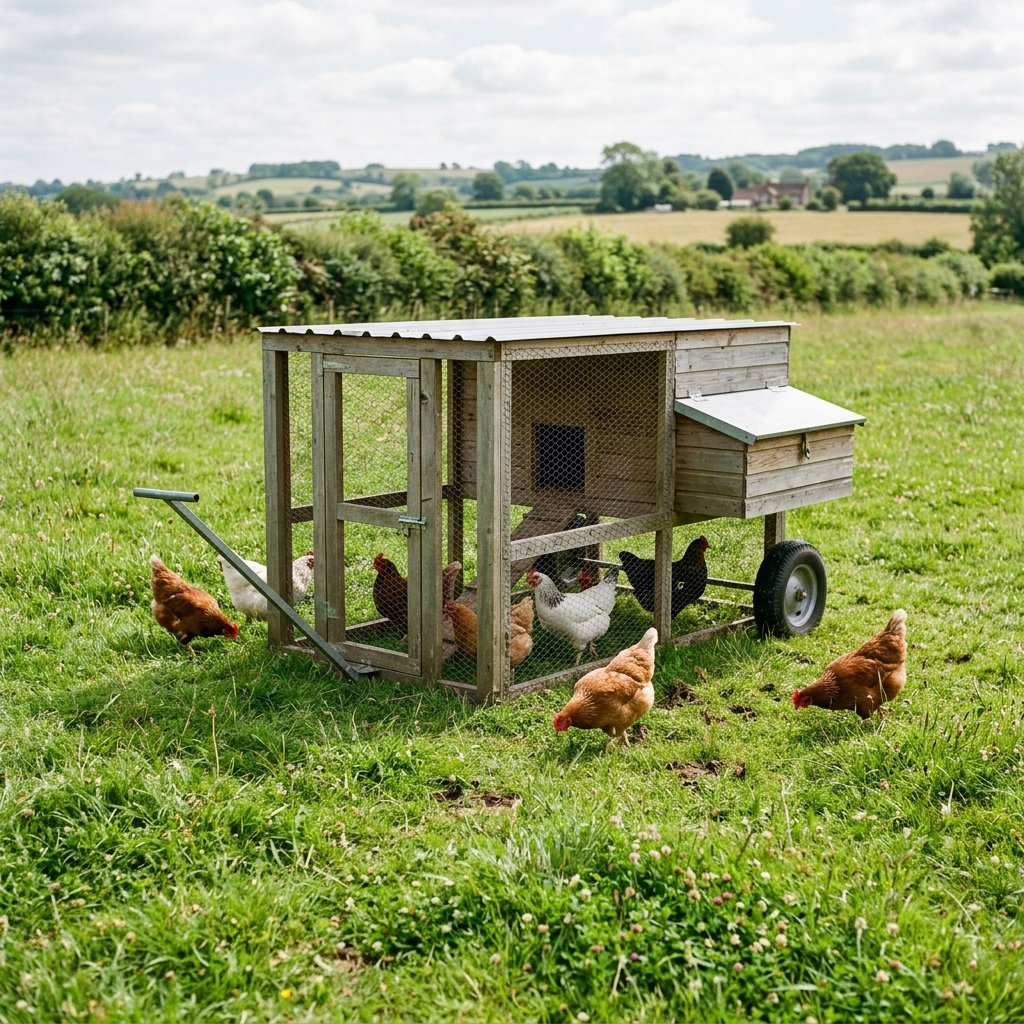
Mobile Chicken Tractors: Size and Design Guide
A chicken tractor is a mobile coop and run combination that lets you move your flock across fresh pasture regularly. The name comes from the way chickens "till" the ground as they scratch, peck, and fertilise — doing garden prep work with no machinery required. For keepers with even a modest garden or small homestead, a well-designed chicken tractor can be one of the most productive tools in the yard.
But size and design matter enormously. A tractor that's too small stresses the birds and damages pasture. One that's too big becomes impossible to move without help. This guide gives you the numbers and design principles to get it right.
How a Chicken Tractor Works
A chicken tractor has no fixed floor — birds have direct access to the ground beneath. You move it regularly (daily to weekly, depending on flock size) to give birds fresh forage and allow used ground to recover. The movement pattern is the key: if you leave the tractor in one spot too long, birds exhaust the vegetation, compact the soil, and create a muddy, ammonia-rich patch that harms the lawn and the flock.
Sizing: How Much Space Does a Chicken Tractor Need?
Sizing a chicken tractor is different from sizing a permanent coop. Because the tractor moves frequently, you can get away with slightly less permanent run space — but the enclosed sleeping section must still meet the indoor minimum, and total tractor size affects how often you need to move it.
| Flock size | Minimum tractor floor area | Recommended move frequency | Approx. dimensions |
|---|---|---|---|
| 2–4 standard hens | 16–24 sq ft total | Every 2–3 days | 4×6 ft or 4×8 ft |
| 4–6 standard hens | 24–40 sq ft total | Daily to every other day | 4×8 ft or 5×8 ft |
| 6–10 standard hens | 40–60 sq ft total | Daily | 6×8 ft or 6×10 ft |
Use our chicken coop calculator to match your flock size to a specific tractor footprint and verify that the sleeping section meets indoor space requirements. For more on run area planning, see our Run Area Planning resources.
The Sleeping Section: Built Into the Tractor
Most chicken tractors have an elevated enclosed box at one end that serves as the sleeping and laying area. This box must meet the same minimum indoor space requirements as any permanent coop: 4 sq ft per standard bird, 2 sq ft per bantam, 5–8 sq ft for large breeds. The sleeping section typically takes up one-third to one-quarter of the tractor's total length.
Nesting boxes in a tractor need to be accessible from outside — a hinged egg door on the side of the enclosed section lets you collect eggs without disturbing the birds or moving the entire structure. Plan for at least one nesting box per three to four hens. For nesting box sizing help, see How to Calculate Nesting Box Space per Chicken.
Weight and Moveability: The Critical Design Trade-off
A chicken tractor is only as useful as your ability to move it. This is where many first-time builders go wrong — they build a tractor with solid wood framing, plywood panels, and heavy hardware, then find it takes two people and a crowbar to shift six inches. Plan your build with weight as the primary design constraint.
Lightweight material choices
Use 1×2 or 1×3 inch furring strips rather than 2×4 lumber for framing wherever structural strength isn't critical. Hardware cloth (not chicken wire) for the run sides is required for predator resistance but can be combined with lightweight PVC conduit hoops on a simple A-frame structure to reduce overall weight dramatically. PVC pipe bends easily into an arch and is self-supporting with minimal hardware — a popular choice for smaller tractors housing up to four birds.
Wheels and handles
Even a modest-weight tractor becomes much easier to move with a pair of wheels on one end and handles on the other — like a wheelbarrow. Position the wheels under the centre of gravity (usually under the sleeping box end). A single axle with 8–10 inch pneumatic wheels handles uneven grass or garden beds with ease. For larger tractors, a two-axle design or a purpose-built dolly under the run section is worth the extra cost.
A-Frame vs. Hoop Tractor vs. Box Tractor
A-frame tractor
The classic design: triangular cross-section, sleeping area in the peak, run area at the base. Structurally strong and relatively easy to build. The sloped sides limit usable run space compared to the footprint, but the angled walls shed rain naturally and provide weather protection without extra roofing. Best for two to four standard hens.
Hoop tractor
PVC or metal conduit bent into arches, covered with hardware cloth and a tarp or polycarbonate sheet on the sleeping section. Extremely lightweight and inexpensive. Less secure than a solid wood build, but adequate in areas without persistent pressure from large predators like coyotes or foxes. Best for three to six bantam or small standard birds.
Box tractor
A fully rectangular design — sleeping box on top, run below. Maximises usable floor space for the footprint. Heavier than A-frame or hoop designs but provides the most head room and is easier to attach nesting boxes and roost bars to. Best for four to eight birds when you have wheels and handles.
Pasture Management with a Chicken Tractor
The benefit of a tractor is only as good as your rotation schedule. Move the tractor before birds run out of forage — not after the ground is bare and compacted. A visual cue: when the green growth inside the tractor looks sparse or has visible bare patches, it's time to move. After vacating a spot, the area typically needs 2–4 weeks to recover and regrow before being used again.
In wet weather, move daily if possible — damp ground compacts faster and ammonia builds up more quickly. In dry summer conditions, you can leave the tractor in one spot slightly longer. Supplement with extra feed during periods when forage is poor, such as mid-summer drought or early spring when growth is slow.
Frequently Asked Questions
How often should I move a chicken tractor?
Move it every 1–3 days depending on flock size and ground condition. The goal is to move before birds deplete vegetation and before droppings start accumulating. In wet weather, daily moves are ideal.
Can a chicken tractor replace a permanent coop?
Yes, for most small flocks. The sleeping section must still meet minimum indoor space requirements. In very cold climates, a more insulated permanent coop may be needed for winter.
What is the best size chicken tractor for 4 hens?
A 4×8 ft tractor works well for four standard hens. The sleeping box at one end should be at least 16 sq ft to meet the 4 sq ft per bird minimum. The open run portion takes up the remaining space.
Is a chicken tractor predator-proof?
A well-built tractor with hardware cloth sides and a solid sleeping section provides good protection against most predators. In areas with persistent digging predators, add an apron of hardware cloth extending outward from the base.